


The Problem
Periodontal (gum) disease is an insidious infection that affects virtually everyone with teeth. This group of diseases originates with bacteria that grow in a sticky matrix commonly called plaque. These bacteria grow back and should be removed daily using toothbrushing and flossing. Mechanical removal of plaque can accomplish just so much, however, since the oral bacteria responsible for periodontal disease are natural residents of the mouth that reattach to teeth immediately after plaque is removed. Some people are more susceptible to periodontal disease than others. Factors such as heredity (where a family has a history of periodontal disease) and lifestyle (such as tobacco and alcohol use, individuals with diabetes) can influence the overgrowth of certain oral bacteria. This overgrowth can damage soft and hard tissues unless it is brought under control and the tissues are allowed to heal. As the gum tissue is damaged, it begins to detach from the tooth exposing the roots. This results in “pockets” being formed. This detached gum pocket is an ideal living space for the bacteria that cause periodontal disease, formerly called pyorrhea – and allows the disease to destroy the underlying bone to which your teeth are anchored.
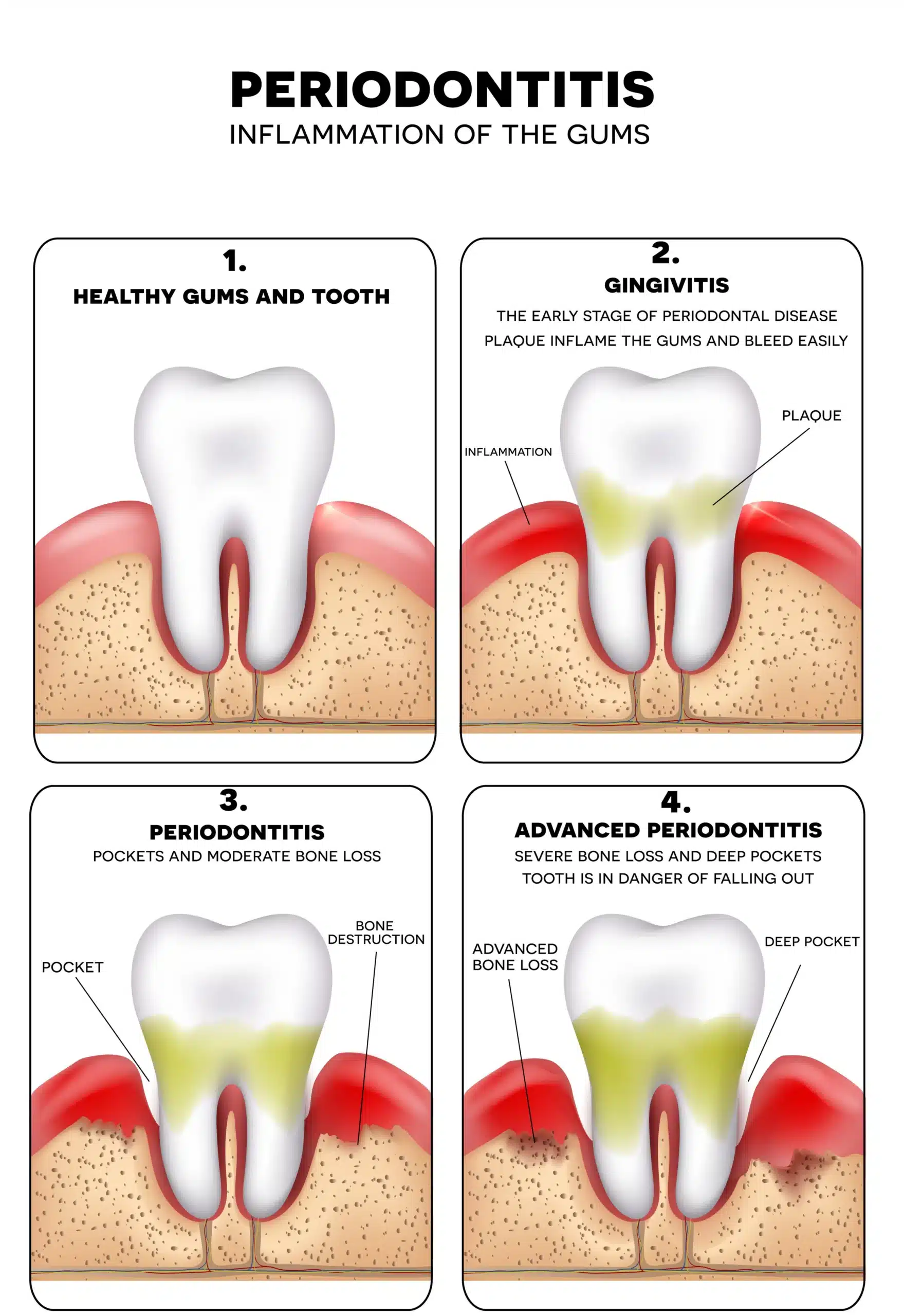
The first bacteria to attach and overgrow on teeth and gums are facilitators; they allow the attachment of more aggressive, forms of bacteria. As more and more aggressive forms attach, they overgrow and disrupt a natural balance in the mouth known as homeostasis. It is at that point that they begin to damage gingival (gum) tissue. This early infection, called gingivitis, may be characterized by slight bleeding or tenderness of the gum tissues, yet most people fail to notice these somewhat subtle warning signs. Fortunately, gingivitis is reversible via the mechanical disruption of the bacterial plaque, since it has not yet moved below the gum line and formed harder to reach spaces (periodontal pockets). Bacterial plaque forms all around the tooth and so, all sides of a tooth and its gum line must be thoroughly cleaned to remove as much bacteria as possible. Normally, this means careful oral hygiene at home, i.e. brushing and flossing. When there is no gum recession, or damage, between the teeth, dental floss is recommended. In cases where the gum has receded between the teeth, specially designed brushes that fit between the teeth are often helpful. Over-the-counter mouthwashes are a way to temporarily cover up bad breath that can be caused by periodontal disease, but do very little to solve the problem. In effect, you are simply ignoring the warning symptoms by masking them.
If gingivitis goes untreated, bacteria may reach the supporting structures of the teeth. One of those structures, a muscle-like ligament that anchors the tooth to the bone, can be destroyed by the action of the bacteria and the body’s response to harmful byproducts released by the bacteria. Once the ligament is destroyed the bacteria can more easily reach the bone itself. For most of us, this destruction is painless, which leads many people to notice the damage only when a tooth actually becomes loose. Unfortunately, that tooth movement usually represents severe periodontal disease – and it presages the loss of the tooth. Early detection of periodontal disease can literally save teeth, but the process can be performed only by a dental professional who employs techniques that can measure the depth of the separation of gum and tooth with an instrument called a periodontal probe. This measurement should always be part of your routine cleaning and check-up at your dentist’s office. Detected in early stages, periodontal disease is easily treatable, but later stages of the disease require more advanced forms of therapy.
We now understand that gum infections can have negative effects on other parts of the body. Individuals with chronic infections, including gum infections, can have more cardiovascular and diabetic problems than people who do not have gum disease.
Solutions For Gum Disease
Prevention
The best way to fight gum disease is to stop it before it destroys gum and bone tissues. Brush and floss daily and have regular checkups done at least once a year by your dentist.
Treating Gingivitis
If you have gingivitis, you may need your teeth professionally cleaned. Tartar (calculus) is often found on your teeth when you have gingivitis. This hardened plaque should be removed by a dental professional since it can harbor plaque and irritate the gums. Patients who have gingivitis should have their teeth cleaned, on average, twice a year. Professional treatment in areas of bone loss is aimed at cleaning the exposed tooth root surface so that the surrounding soft tissues can reattach.
Nonsurgical Deep Cleaning Utilizing the Dental Endoscope
Most people, over time, build up tartar on their teeth under the gum line. Tartar on the root surface is like dirt in a wound, it must be removed for the wound to heal. In the early stages of gum disease, tartar below the gum has traditionally been removed by blind scraping the root surface without seeing the deposit. Today, we understand that this “blind” approach can leave bacteria and tartar at the tooth, which in turn can lead to re-infection.
The dental endoscope is a device with a very small camera that allows us to look at tartar without surgery. This allows more of the bacteria and tartar to be removed. The device magnifies surfaces up to 50 times, allowing the visualization of deposits invisible to the naked eye. For the patient this means a cleaner tooth, better gum repair and, in many cases, no need for surgical intervention. It works best to treat the early stages of bone loss.
Videoscope-Assisted Minimally Invasive Surgery (V-MIS)
In cases where more bone has been lost we need to regenerate (regrow) bone that has been lost to periodontal disease, the videoscope makes it possible to gently tease back the gums. This gives us a better view of the tartar and a greater ability to remove it. When combined with the application of biomaterials that encourage the regeneration of gum and bone, such as enamel matrix derivatives (see below), the surgical result is more predictable and more comfortable, usually with far less gum recession than other traditional periodontal treatment methods.
Enamel Matrix Derivatives (Emdogain)
Enamel matrix derivatives (EMD’s) are naturally occurring signaling proteins found in all humans that help regulate the formation of our teeth. Like a multitude of proteins throughout our bodies, EMD’s are building blocks within the body cells. Similar proteins are found around the developing teeth of all mammals. First isolated in the 1980s, EMD’s have been found to generate new bone around teeth and a new periodontal ligament that attaches the bone to the teeth. Those regenerative properties have made EMD’s very valuable in the restoration of health and regrowing bone around teeth ravaged by periodontal disease.
The EMD’s used in periodontal treatment are of porcine origin. Their use for treating periodontitis and gum recession has been approved by the U.S. Food and Drug Administration.
Before EMD’s can be applied, the affected teeth are given a thorough cleaning to remove tartar and bacterial plaque using the endoscope or videoscope. Once placed these proteins quickly form an interactive yet invisible layer on the teeth which, can significantly augment healing following treatment of gum disease and implant placement.
Advanced Periodontal Therapy (Endoscopic + Laser-Assisted)
Gum disease is caused by bacteria and inflammation beneath the gumline—an area that has traditionally been treated “blindly” with deep cleanings or surgery.
We take a more precise approach.
Using endoscopic technology, we can see below the gumline in real time — allowing us to remove bacteria and buildup with much greater precision than traditional methods.
How Treatment Works
Using a tiny endoscopic camera, we carefully examine the root surfaces below the gumline. This allows us to:
- Precisely remove plaque, tartar, and bacterial buildup
- Thoroughly clean areas that are often missed with traditional methods
- Minimize unnecessary trauma to healthy tissue.
We then use laser-assisted therapy to disinfect the area, reduce inflammation, and promote healing. In many cases, this approach can significantly reduce the need for more invasive surgical procedures.
Regenerative & Bone Grafting Options
When bone loss has occurred, we may incorporate regenerative procedures (GTR) during treatment. This can include bone grafting and biologic materials to help rebuild lost support around the teeth and improve long-term stability.
Treatment for Dental Implants (Peri-Implantitis)
This same technology is highly effective for treating inflammation and bone loss around dental implants (peri-implantitis). The endoscope allows us to clean implant surfaces with precision while preserving surrounding tissue—something that is difficult to achieve with traditional techniques.
Comfort & Recovery
Our approach is designed to be as comfortable and efficient as possible:
- Minimally invasive, with less bleeding and swelling
- Local anesthesia and sedation options are available for comfort
- Many patients are surprised by how straightforward the experience is—and how quickly they return to normal.
A More Precise Way to Treat Gum Disease
After treatment, we re-evaluate your healing and customize a maintenance plan to keep your gums healthy long-term. By combining visualization, laser therapy, and regenerative techniques, we’re able to treat gum disease more effectively—while preserving as much of your natural tissue as possible.
FAQs About Gum Disease
If periodontal diseases are caused by bacteria, why can’t I simply take antibiotics to cure the infection?
There are many types of bacteria, acting alone or in concert with other types, that lead to periodontal disease. The simple answer is that no one antibiotic or combination can kill all the types of bacteria that may be involved in periodontal disease.
Are there diets or dietary supplements that will help reduce the damage from the disease?
Bacteria feed on virtually any food that is trapped in the mouth. While diet can play a role in oral health, it is oral hygiene and the frequency of eating that are most important. It is important to thoroughly clean the teeth at least twice a day, preferably soon after eating. An important diet-related factor is the frequency of eating. Even daily toothbrushing might not be able to keep up with frequent eating occasions throughout the day. Each instance “feeds” the oral bacteria. Avoiding frequent snacking on foods containing refined sugars and starches will help reduce the growth of plaque that can cause gum disease and dental decay.
Does it take longer to do a deep cleaning using the endoscope or videoscope?
Yes. Because your therapist can now actually see microscopic deposits of tartar that would have been missed with the naked eye, it will take longer to remove them.